
We used to think protein needs varied dramatically depending on whether you were cutting to lose fat, bulking to build muscle, or just maintaining your current physique.
But newer research tells a simpler story.
Most people in most situations should eat about 0.8-to-1 gram of protein per pound of body weight per day. This recommendation holds true whether your main goal is muscle gain, fat loss, or simply staying healthy.
That said, protein requirements can shift slightly depending on your circumstances. Let’s take a closer look at what the latest research says about exactly how much protein you should eat a day.
Key Takeaways
- To gain muscle, aim for 0.8-to-1 g/lb/day. Eating more than that doesn’t help you build muscle faster and just squeezes out carbs and fat from your diet.
- To lose fat without losing muscle, eat between 0.4-to-1 g/lb/day depending on how active you are. If you lift weights regularly, stick to the higher end of the range.
- To maintain your body composition, 0.8 g/lb/day is usually enough.
- If you’re over 60, aim for 0.6-to-0.8 g/lb/day to stay strong, mobile, and healthy.
- You don’t need protein immediately after a workout, but having 20-to-40 grams within a couple of hours is a simple way to support recovery and muscle growth.
- Protein needs for women are the same as for men—around 0.8-to-1 g/lb/day. Women usually need less protein overall simply because they tend to weigh less.
- To make reaching your protein goal easier, consider using protein supplements like Whey+, Casein+, Clear Whey, or protein bars and cookies.
How Much Protein Should You Eat a Day?
Many people think the Recommended Dietary Allowance (RDA) of 0.36 grams of protein per pound of body weight per day (g/lb/day) is a good baseline intake.
Several studies show, however, that it isn’t enough to maintain or build muscle, optimize fat loss, or maximize your performance.
It’s probably not enough to maintain good health, either. According to research published in the journal Current Opinion in Clinical Nutrition and Metabolic Care, a more reasonable minimum amount for staying healthy is 0.42 g/lb/day.
If you’re active, eating more than this is helpful. How much more, though, is up for debate.
While research shows that it’s safe to eat large amounts of protein—1.5-to-2+ g/lb/day, for instance—it usually isn’t better for improving your body composition or health than a more moderate protein intake of around 0.8-to-1 g/lb/day.
Despite this, some people choose to eat more, often just to hedge their bets. Since protein needs can vary from person to person—and there’s no way to know exactly where you fall—eating a little more than necessary feels like a low-risk way to cover your bases.
In practice, that usually means eating around 1-to-1.2 g/lb/day. There’s no real upside to going higher than that. It won’t help you build more muscle, and it just cuts into how much carbohydrate and fat you can eat—which can make dieting tougher than it needs to be.
How Much Protein Do I Need to Gain Muscle?
If your main goal is to gain muscle, aim for around 0.8-to-1 g/lb/day.
A meta-analysis of 49 studies published in the British Journal of Sports Medicine found that consuming 0.7-to-0.8 g/lb/day is enough to maximize muscle gain for most weightlifters. That is, eating more than this doesn’t usually produce better results.
However, protein needs can vary depending on factors like your genetics, activity level, training volume, and weightlifting experience, so nudging that up to 1 g/lb/day is a practical upper limit. Doing so gives you a bit of wiggle room without drastically reducing space in your diet for carbs and fats.
How Much Protein Do I Need to Lose Weight (Without Losing Muscle)?
To lose fat while minimizing muscle loss, research shows you should eat 0.4-to-1 g/lb/day depending on your activity level.
If you lift weights or do intense training several times weekly, 0.8-to-1 g/lb/day is a good target.
If you’re active but not lifting or doing long or hard workouts, you can get by with a bit less—around 0.5-to-0.7 g/lb/day. And if you’re sedentary (which isn’t ideal for fat loss or health), the bare minimum to avoid muscle loss is around 0.4 g/lb/day.
How Much Protein Do I Need to Maintain Muscle?
To maintain muscle mass without losing or gaining body weight, around 0.8 g/lb/day is sufficient for most people. If you regularly lift weights or do other intense exercise, bump this up closer to 1 g/lb/day.
How Much Protein Do Seniors Need?
For most people over 60, eating 0.6-to-0.8 g/lb/day helps preserve muscle and strength.
If you’re sedentary, 0.6 g/lb/day is usually enough, but if you lift weights or stay active, aiming for around 0.8 g/lb/day is better.
As you get older, holding onto muscle is key to staying mobile, avoiding falls and fractures, and protecting yourself against illness and frailty. And getting enough protein is one of the most effective ways to do that.
How Much Protein Should I Eat After a Workout?
There’s a long-held belief that you need to have protein immediately after a workout or you’ll miss your chance to build muscle. This idea mostly comes from short-term studies showing a spike in muscle protein synthesis when you consume amino acids immediately after training.
However, a meta-analysis of 23 studies published in the Journal of the International Society of Sports Nutrition found that having protein right after your workout doesn’t seem to make a meaningful difference in muscle growth or strength gains, provided your total daily protein intake is high enough.
That said, many people still wonder how much protein after a workout is ideal. A good rule of thumb is to aim for 20-to-40 grams within a couple of hours of training. It’s not essential, but it’s a simple habit that helps cover your bases—and it definitely won’t hurt.
How Much Protein Does a Woman Need?

Many people overthink protein requirements for women, claiming that they need far less than men, or dramatically different macro ratios.
In reality, protein needs for women don’t differ much from those for men. Aim for about 0.8-to-1 g/lb/day, based on your goals and activity level.
Tips for Getting Enough Protein Per Day
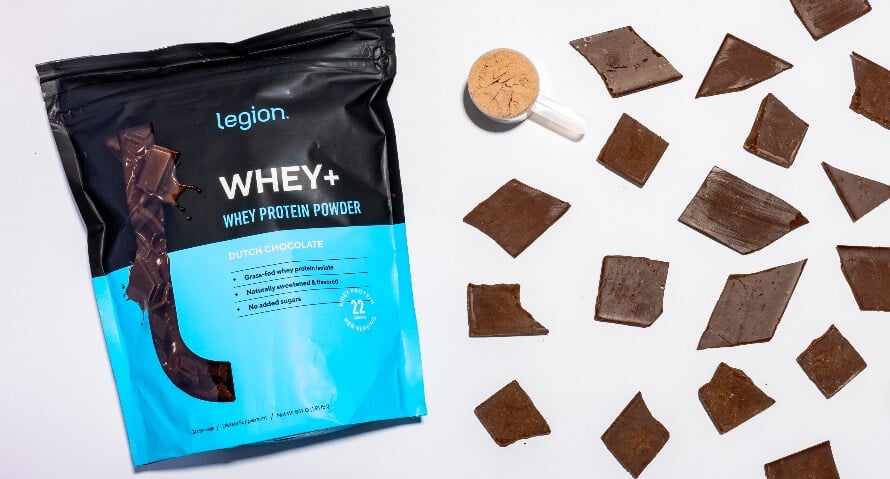
Now you know how much protein you need a day, here are some ways to make hitting that target straightforward:
- Eat 30-to-40 grams of protein per meal: Aim for 3-to-4 meals like this daily, and you’ll have no issues hitting your protein target.
- Supplement with protein powder, bars, and cookies: Powders, bars, and cookies are easy, tasty ways to boost your intake when you’re busy or not in the mood to cook.
- Snack on high-protein foods: Stock up on simple options like Greek yogurt, cottage cheese, jerky, meat sticks, hard-boiled eggs, and edamame.
FAQ #1: How do I calculate how much protein I need?
The easiest and most accurate method is to use the Legion Protein Calculator. Or for a slightly less precise answer, multiply your body weight (in pounds) by 0.8-to-1.
FAQ #2: Are protein needs for women different from men?
No—protein requirements for women are the same as those for men. Both usually need around 0.8-to-1 g/lb/day. Of course, men typically have to eat more simply because they tend to weigh more.
FAQ #3: How many scoops of whey protein should I have per day?
There’s no hard and fast rule about how much whey protein you should have per day, but 1-to-2 scoops works well for most people. Just use it whenever it’s convenient to help you hit your daily protein target.
FAQ #4: How much protein’s in a chicken drumstick?
A typical medium-sized chicken drumstick contains roughly 12-to-15 grams of protein.
FAQ #5: How much protein’s in bacon?
One strip of cooked bacon has about 3 grams of protein.
FAQ #6: How much protein’s in a steak?
Lean cuts of steak, such as top sirloin, eye of round, or tenderloin, average about 25 grams of protein per 4-ounce serving.
Scientific References +
- Weiler, Mary, et al. “Is It Time to Reconsider the U.S. Recommendations for Dietary Protein and Amino Acid Intake?” Nutrients, vol. 15, no. 4, 6 Feb. 2023, p. 838, https://doi.org/10.3390/nu15040838.
- Humayun, Mohammad A, et al. “Reevaluation of the Protein Requirement in Young Men with the Indicator Amino Acid Oxidation Technique.” The American Journal of Clinical Nutrition, vol. 86, no. 4, 1 Oct. 2007, pp. 995–1002, https://doi.org/10.1093/ajcn/86.4.995.
- Rafii, Mahroukh, et al. “Dietary Protein Requirement of Men >65 Years Old Determined by the Indicator Amino Acid Oxidation Technique Is Higher than the Current Estimated Average Requirement.” The Journal of Nutrition, vol. 146, no. 4, 1 Apr. 2015, pp. 681–687, https://doi.org/10.3945/jn.115.225631.
- Tang, Minghua, et al. “Assessment of Protein Requirement in Octogenarian Women with Use of the Indicator Amino Acid Oxidation Technique.” The American Journal of Clinical Nutrition, vol. 99, no. 4, 15 Jan. 2014, pp. 891–898, https://doi.org/10.3945/ajcn.112.042325.
- Rafii, Mahroukh, et al. “Dietary Protein Requirement of Female Adults >65 Years Determined by the Indicator Amino Acid Oxidation Technique Is Higher than Current Recommendations.” The Journal of Nutrition, vol. 145, no. 1, 15 Oct. 2014, pp. 18–24, https://doi.org/10.3945/jn.114.197517.
- Elango, Rajavel, et al. “Evidence That Protein Requirements Have Been Significantly Underestimated.” Current Opinion in Clinical Nutrition and Metabolic Care, vol. 13, no. 1, Jan. 2010, pp. 52–57, https://doi.org/10.1097/mco.0b013e328332f9b7.
- Antonio, Jose, et al. “The Effects of Consuming a High Protein Diet (4.4 G/Kg/D) on Body Composition in Resistance-Trained Individuals.” Journal of the International Society of Sports Nutrition, vol. 11, no. 1, 12 May 2014, https://doi.org/10.1186/1550-2783-11-19.
- Houltham, Stuart Douglas, and David S. Rowlands. “A Snapshot of Nitrogen Balance in Endurance-Trained Women.” Applied Physiology, Nutrition, and Metabolism = Physiologie Appliquee, Nutrition et Metabolisme, vol. 39, no. 2, 1 Feb. 2014, pp. 219–225, www.ncbi.nlm.nih.gov/pubmed/24476478, https://doi.org/10.1139/apnm-2013-0182.
- Morton, Robert W, et al. “A Systematic Review, Meta-Analysis and Meta-Regression of the Effect of Protein Supplementation on Resistance Training-Induced Gains in Muscle Mass and Strength in Healthy Adults.” British Journal of Sports Medicine, vol. 52, no. 6, 11 July 2017, pp. 376–384, https://doi.org/10.1136/bjsports-2017-097608.
- Bandegan, Arash, et al. “Indicator Amino Acid–Derived Estimate of Dietary Protein Requirement for Male Bodybuilders on a Nontraining Day Is Several-Fold Greater than the Current Recommended Dietary Allowance.” The Journal of Nutrition, vol. 147, no. 5, 8 Feb. 2017, pp. 850–857, https://doi.org/10.3945/jn.116.236331.
- Campbell, Wayne W, et al. “Higher Total Protein Intake and Change in Total Protein Intake Affect Body Composition but Not Metabolic Syndrome Indexes in Middle-Aged Overweight and Obese Adults Who Perform Resistance and Aerobic Exercise for 36 Weeks.” The Journal of Nutrition, vol. 145, no. 9, 5 Aug. 2015, pp. 2076–2083, www.ncbi.nlm.nih.gov/pmc/articles/PMC4548166/pdf/jn213595.pdf, https://doi.org/10.3945/jn.115.213595.
- Walberg, J., et al. “Macronutrient Content of a Hypoenergy Diet Affects Nitrogen Retention and Muscle Function in Weight Lifters.” International Journal of Sports Medicine, vol. 09, no. 04, Aug. 1988, pp. 261–266, https://doi.org/10.1055/s-2007-1025018.
- Hudson, Joshua L, et al. “Protein Intake Greater than the RDA Differentially Influences Whole-Body Lean Mass Responses to Purposeful Catabolic and Anabolic Stressors: A Systematic Review and Meta-Analysis.” Advances in Nutrition, vol. 11, no. 3, 3 Dec. 2019, pp. 548–558, https://doi.org/10.1093/advances/nmz106.
- Increased protein intake reduces lean body mass loss during weight loss in athletes. – PubMed – NCBI. https://www.ncbi.nlm.nih.gov/pubmed/19927027/. Accessed December 13, 2019.
- Moore, Daniel R. “Protein Requirements for Master Athletes: Just Older Versions of Their Younger Selves.” Sports Medicine, vol. 51, 13 Sept. 2021, https://doi.org/10.1007/s40279-021-01510-0.
- Coelho-Júnior, Hélio, et al. “Relative Protein Intake and Physical Function in Older Adults: A Systematic Review and Meta-Analysis of Observational Studies.” Nutrients, vol. 10, no. 9, 19 Sept. 2018, p. 1330, https://doi.org/10.3390/nu10091330.
- Wallace, Taylor C., and Cara L. Frankenfeld. “Dietary Protein Intake above the Current RDA and Bone Health: A Systematic Review and Meta-Analysis.” Journal of the American College of Nutrition, vol. 36, no. 6, 7 July 2017, pp. 481–496, https://doi.org/10.1080/07315724.2017.1322924.
- Ardisson Korat, Andres , et al. Dietary Protein Intake in Midlife in Relation to Healthy Aging – Results from the Prospective Nurses’ Health Study Cohort. 4 Aug. 2023, https://doi.org/10.1016/j.ajcnut.2023.11.010.
- Jang, Young Jin. “The Effects of Protein and Supplements on Sarcopenia in Human Clinical Studies: How Older Adults Should Consume Protein and Supplements.” Journal of Microbiology and Biotechnology, vol. 33, no. 2, 31 Oct. 2022, https://doi.org/10.4014/jmb.2210.10014.
- Tipton, K D, et al. “Postexercise Net Protein Synthesis in Human Muscle from Orally Administered Amino Acids.” The American Journal of Physiology, vol. 276, no. 4, 1999, pp. E628-34, www.ncbi.nlm.nih.gov/pubmed/10198297/, https://doi.org/10.1152/ajpendo.1999.276.4.E628.
- Børsheim, Elisabet, et al. “Essential Amino Acids and Muscle Protein Recovery from Resistance Exercise.” American Journal of Physiology-Endocrinology and Metabolism, vol. 283, no. 4, 1 Oct. 2002, pp. E648–E657, https://doi.org/10.1152/ajpendo.00466.2001.
- Tipton, K D, et al. “Timing of Amino Acid-Carbohydrate Ingestion Alters Anabolic Response of Muscle to Resistance Exercise.” American Journal of Physiology. Endocrinology and Metabolism, vol. 281, no. 2, 2001, pp. E197-206, www.ncbi.nlm.nih.gov/pubmed/11440894, https://doi.org/10.1152/ajpendo.2001.281.2.E197.
- Bj, Schoenfeld, et al. “The Effect of Protein Timing on Muscle Strength and Hypertrophy: A Meta-Analysis.” Journal of the International Society of Sports Nutrition, 3 Dec. 2013, pubmed.ncbi.nlm.nih.gov/24299050/.
- MALOWANY, JULIA M., et al. “Protein to Maximize Whole-Body Anabolism in Resistance-Trained Females after Exercise.” Medicine & Science in Sports & Exercise, vol. 51, no. 4, Apr. 2019, pp. 798–804, https://doi.org/10.1249/mss.0000000000001832. Accessed 17 June 2020.